Table Of Content
Overall, then, stepped wedges represent useful tools for evaluating the impact of health interventions that (as with all designs) are subject to certain weaknesses and limitations. Another alternative explanation for a change in the dependent variable in a pretest-posttest design is regression to the mean. Regression to the mean can be a problem when participants are selected for further study because of their extreme scores. A closely related concept—and an extremely important one in psychological research—is spontaneous remission. In reviewing the results of several studies of treatments for depression, researchers Michael Posternak and Ivan Miller found that participants in waitlist control conditions improved an average of 10 to 15% before they received any treatment at all (Posternak & Miller, 2001).
Discontinuity in regression
Thus, such designs are well-suited to answering questions about what implementation strategies should be used, in what order, to achieve the best outcomes in a given context. In comparison to simple pre-post designs in which the average outcome level is compared between the pre- and post-intervention periods, the key advantage of ITS designs is that they evaluate for intervention effect while accounting for pre-intervention trends. Such trends are common due to factors such as changes in the quality of care, data collection and recording, and population characteristics over time.
Conducting an Experiment in Psychology - Verywell Mind
Conducting an Experiment in Psychology.
Posted: Mon, 30 Oct 2023 07:00:00 GMT [source]
What Are the Threats to Establishing Causality When Using Quasi-experimental Designs in Medical Informatics?
SWDs can include cohort designs (with the same individuals in each cluster in the pre and post intervention steps), and repeated cross-sectional designs (with different individuals in each cluster in the pre and post intervention steps) (7). In the SWD, there is a unidirectional, sequential roll- out of an intervention to clusters (or individuals) that occurs over different time periods. Initially all clusters (or individuals) are unexposed to the intervention, and then at regular intervals, selected clusters cross over (or ‘step’) into a time period where they receive the intervention [Figure 3 here]. All clusters receive the intervention by the last time interval (although not all individuals within clusters necessarily receive the intervention).
Article Level Metrics
This does not mean that the chicken soup was responsible for the improvement, however, because they would have been much improved without any treatment at all. A group of severely depressed people today is likely to be less depressed on average in 6 months. In reviewing the results of several studies of treatments for depression, researchers Michael Posternak and Ivan Miller found that participants in waitlist control conditions improved an average of 10 to 15% before they received any treatment at all (Posternak & Miller, 2001)[2]. Thus one must generally be very cautious about inferring causality from pretest-posttest designs. First, because they feature delayed implementation at some sites, stepped wedges typically take longer than similarly-sized parallel group RCTs.
Quasi-experimental research compares groups with different circumstances or treatments to find cause-and-effect links. This method is used to examine the impact of an intervention or treatment over time by comparing data collected before and after the intervention or treatment. At this design stage, the first step at improving internal validity would be focused on selection of a non-equivalent control group(s) for which some balance in the distribution of known risk factors is established.
1. Pre-Post with Non-Equivalent Control Group
The resulting confounding between site assignment and time can threaten the internal validity of the study—although, as above, balancing algorithms can reduce this risk. Third, the use of formative evaluation (Elwy, this issue), while useful for maximizing the utility of implementation efforts in a stepped wedge, can mean that late-wave sites receive different implementation strategies than early-wave sites. Similarly, formative evaluation may inform midstream adaptations to the clinical innovation being implemented.
Experimental Designs in Implementation Science
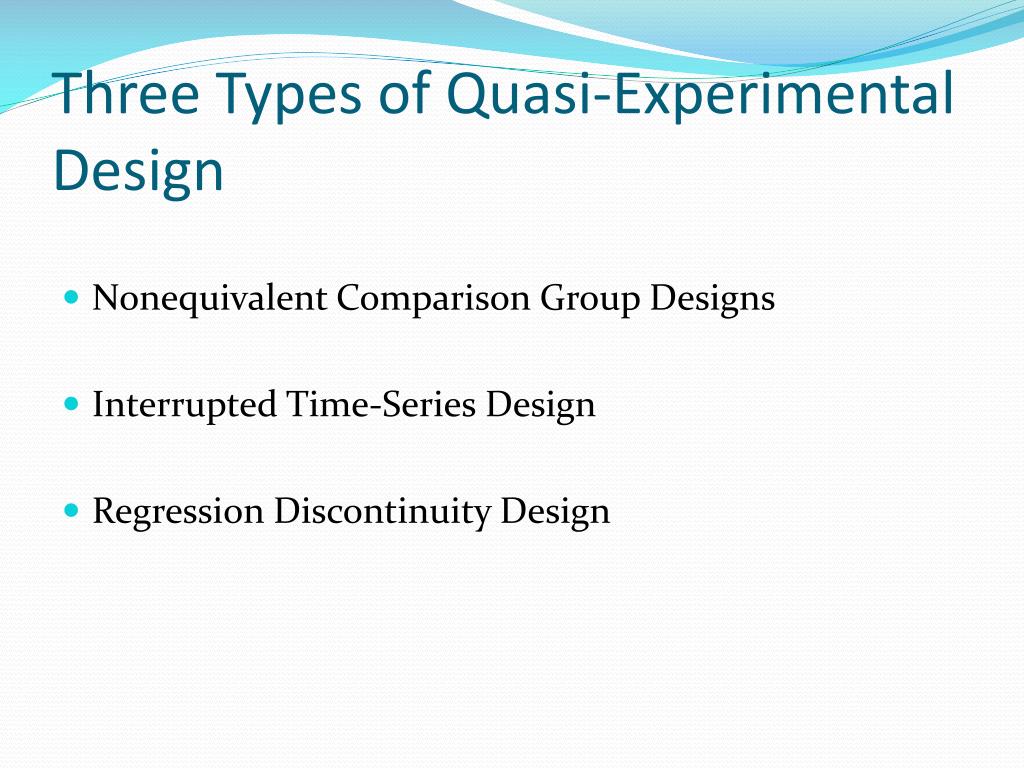
He noted that when the average height of the parents was greater than the mean of the population, the children tended to be shorter than their parents, and conversely, when the average height of the parents was shorter than the population mean, the children tended to be taller than their parents. To get the true effect of the intervention of interest, we need to control for the confounding variable. You can use two-group tests, time-series analysis, and regression analysis to analyze data in a quasi-experiment design. This kind of experiment would raise ethical concerns since the participants assigned to the treatment group are required to eat junk food against their will throughout the experiment. This type of quasi-experimental research design calculates the impact of a specific treatment or intervention. This design involves selecting participants based on a specific cutoff point on a continuous variable, such as a test score.
New communication tool for basic life support training: smart glasses. A quasi-experimental study - ScienceDirect.com
New communication tool for basic life support training: smart glasses. A quasi-experimental study.
Posted: Fri, 03 Nov 2023 13:06:39 GMT [source]
Internal validity is defined as the degree to which observed changes in outcomes can be correctly inferred to be caused by an exposure or an intervention. Quasi-experimental study designs, often described as nonrandomized, pre-post intervention studies, are common in the medical informatics literature. Yet little has been written about the benefits and limitations of the quasi-experimental approach as applied to informatics studies.
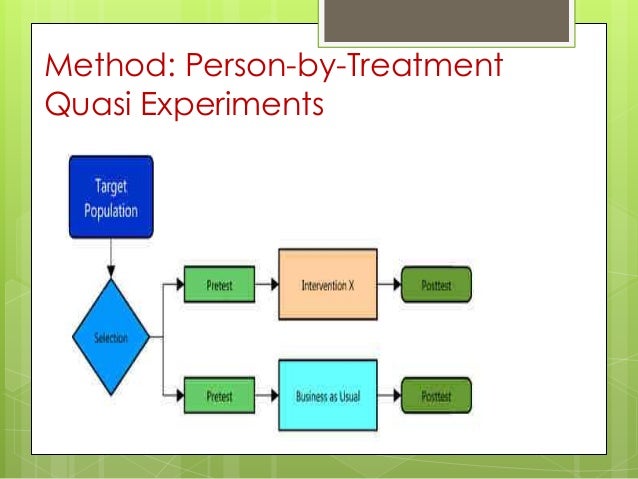
Relative to an RCT, ITS designs can also allow for a more comprehensive assessment of the longitudinal effects of an intervention (positive or negative), as effects can be traced over all included time points (Bernal et al., 2017; Penfold and Zhang, 2013). But at the same time there is a control group that is given a pretest, does not receive the treatment, and then is given a posttest. The question, then, is not simply whether participants who receive the treatment improve but whether they improve more than participants who do not receive the treatment. Table 2 provides examples of studies using SWD that have used one or more of the design approaches described above to improve the internal validity of the study. In the study by Killam et al 2010 (31), a non-randomized SWD was used to evaluate a complex clinic-based intervention for integrating anti-retro viral (ART) treatment into routine antenatal care in Zambia for post-partum women.
Because in this study design, the two groups may not be equivalent (assignment to the groups is not by randomization), confounding may exist. For example, suppose that a pharmacy order-entry intervention was instituted in the medical intensive care unit (MICU) and not the surgical intensive care unit (SICU). O1 would be pharmacy costs in the MICU after the intervention and O2 would be pharmacy costs in the SICU after the intervention. Also, the absence of pretest measurements comparing the SICU to the MICU makes it difficult to know whether differences in O1 and O2 are due to the intervention or due to other differences in the two units (confounding variables). In this paper, we review the different pretest-posttest quasi-experimental study designs, their nomenclature, and the relative hierarchy of these designs with respect to their ability to establish causal associations between an intervention and an outcome. The example of a pharmacy order-entry system aimed at decreasing pharmacy costs will be used throughout this article to illustrate the different quasi-experimental designs.
In the present example, the researcher could try to select two classes at the same school, where the students in the two classes have similar scores on a standardized math test and the teachers are the same sex, are close in age, and have similar teaching styles. Taking such steps would increase the internal validity of the study because it would eliminate some of the most important confounding variables. But without true random assignment of the students to conditions, there remains the possibility of other important confounding variables that the researcher was not able to control. The use of both a pretest and a comparison group makes it easier to avoid certain threats to validity. However, because the two groups are nonequivalent (assignment to the groups is not by randomization), selection bias may exist.




No comments:
Post a Comment